
Completion requirements
💡
Choose Your Learning Material
This the lesson is available in multiple formats The content is the same—feel free to choose the one way that fits your current learning environment. You do not need to complete all
VIDEO VERSION:
AUDIO VERSION:
SLIDE VERSION:
READING VERSION:
1. What Is Software Testing?
Software testing is the process of evaluating a software product to determine whether it meets specified requirements, works as users expect, and reveals defects, risks, or gaps in behavior.
👉 In Simple Words:
Testing is about checking software behavior, not proving it is perfect.
Core Goals of Software Testing
-
Find defects early: Catch issues before they reach the user.
-
Reduce risk: Ensure the product is safe to release.
-
Increase confidence: Give stakeholders trust in the product's quality.
-
Protect users & business: Prevent data loss, financial errors, or bad user experiences.
Testing answers critical questions like:
-
"Does this feature work as intended?"
-
"What happens if the user does something unexpected?"
-
"Where can the system break?"
2. What Software Testing Is NOT
Many beginners misunderstand testing. It is crucial to set the right expectations.
❌ Testing Is NOT:
-
Just clicking around randomly.
-
Only checking "happy paths" (scenarios where everything goes right).
-
Verifying that developers are always wrong.
-
Guaranteeing bug-free software.
-
Only done after coding is finished.
-
Only about finding bugs.
Key Insight: If you only check that things work, you are validating, not testing. Testing is about thinking critically, not blindly confirming success.
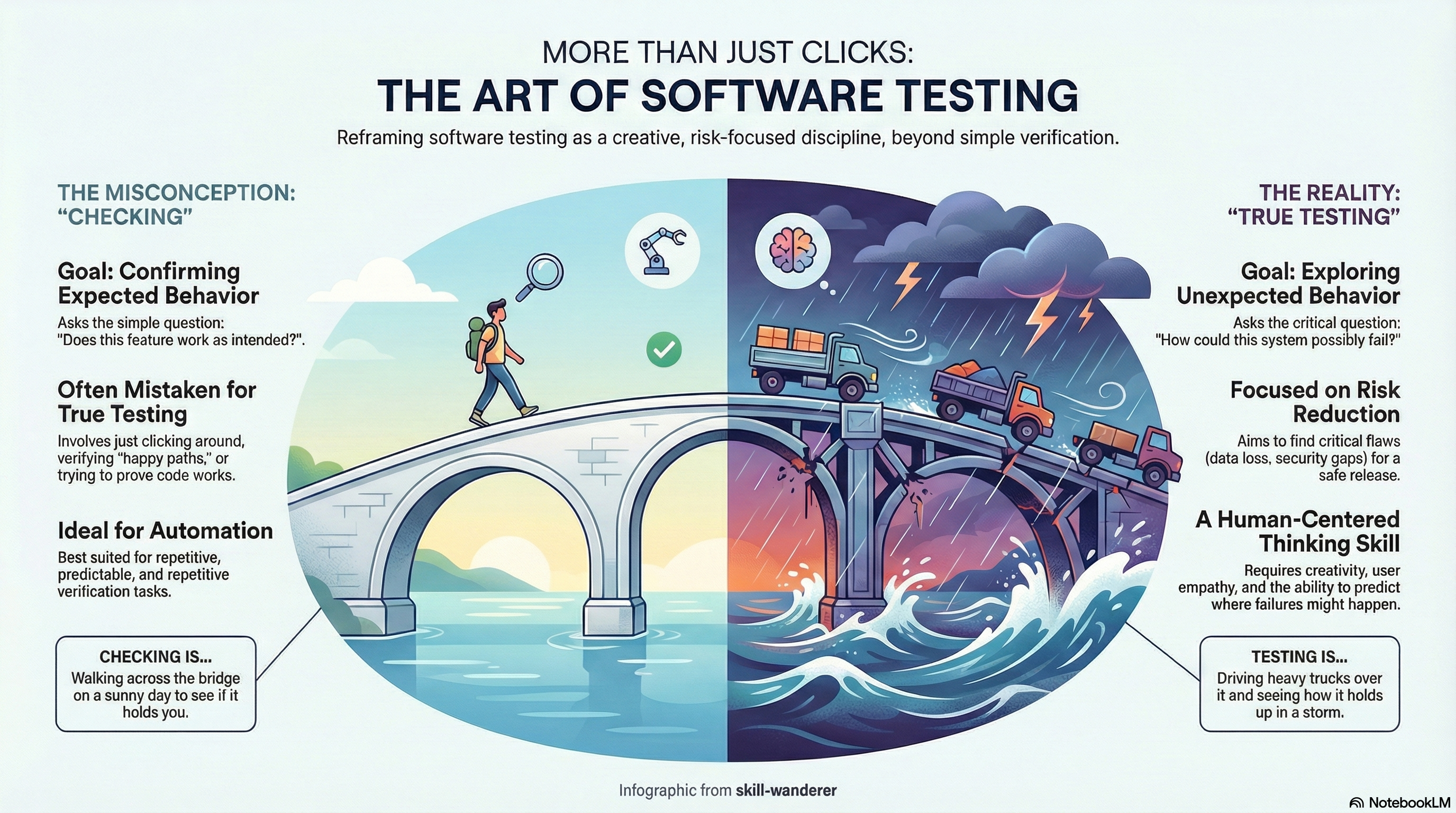
3. Testing vs. Checking (Critical Concept)
Understanding the difference between these two activities is what separates a novice from a professional.
| Feature | Checking | Testing |
| Goal | Confirming expected behavior. | Exploring unexpected behavior. |
| Question | "Does this work?" | "How could this fail?" |
| Nature | Repetitive. | Analytical & Creative. |
| Automation | Easy to automate. | Best for human testers. |
Takeaway: Manual testers add the most value through Testing (exploration and analysis), not just Checking (verification).
4. Why Testing Is Necessary
Even simple apps can fail. Testing bridges the gap between intent (what we wanted) and reality (what we built).
Common reasons for failure:
-
Misunderstood requirements: The developer built the wrong thing.
-
Edge cases: Scenarios developers didn't consider (e.g., negative numbers, empty fields).
-
User behavior: Users rarely follow the "happy path."
-
Environment differences: Browsers, devices, and operating systems behave differently.
-
Human assumptions: "I thought the API would handle that..."
"Code works exactly as written — not as intended."
5. Testing Is About Risk Reduction
Testing does not eliminate all bugs. It reduces the risk of release to an acceptable level.
Examples of risks testers look for:
-
Data loss: A user saves a file, and it disappears.
-
Security flaws: Sensitive data is exposed.
-
Financial miscalculations: A shopping cart totals the wrong amount.
-
System crashes: The app closes unexpectedly.
-
Bad user experience: The app is confusing or slow.
The Goal: Not perfection, but a safe release.
6. Testing Is a Thinking Skill
A common beginner misconception is: "I need to learn automation tools to be a tester."
The Reality:
-
Tools help you later.
-
Thinking matters first.
A good tester focuses on:
-
Asking the right questions.
-
Understanding the user's perspective.
-
Predicting where failures might happen.
-
Observing behavior carefully.
7. Real-Life Analogy: The Bridge
Imagine you are testing a newly built bridge.
-
Checking: Walking across it once on a sunny day to see if it holds you.
-
Testing:
-
Driving a heavy truck over it.
-
Checking how it sways in a storm (bad weather).
-
Seeing what happens if traffic stops in the middle (unusual usage).
-
Software testing works the same way—we stress the system to ensure it holds up under pressure.
8. 📝 Key Takeaways for Learners
-
Testing ≠ Proving software works.
-
Testing = Finding risks and weaknesses.
-
Humans are best at exploratory thinking; machines are best at checking.
-
Manual testing is a professional skill requiring creativity, not a fallback job.
Last modified: Wednesday, 7 January 2026, 6:37 AM