Completion requirements
💡
Choose Your Learning Material
This the lesson is available in multiple formats The content is the same—feel free to choose the one way that fits your current learning environment. You do not need to complete all
VIDEO VERSION:
PODCAST VERSION:
SLIDE VERSION:
READING VERSION:
1. The Honest Truth About Bugs
Bugs are normal. They exist in every software system—from small websites to banking apps, from early-stage startups to global tech giants.
Key Principle: If software has users, it has bugs.
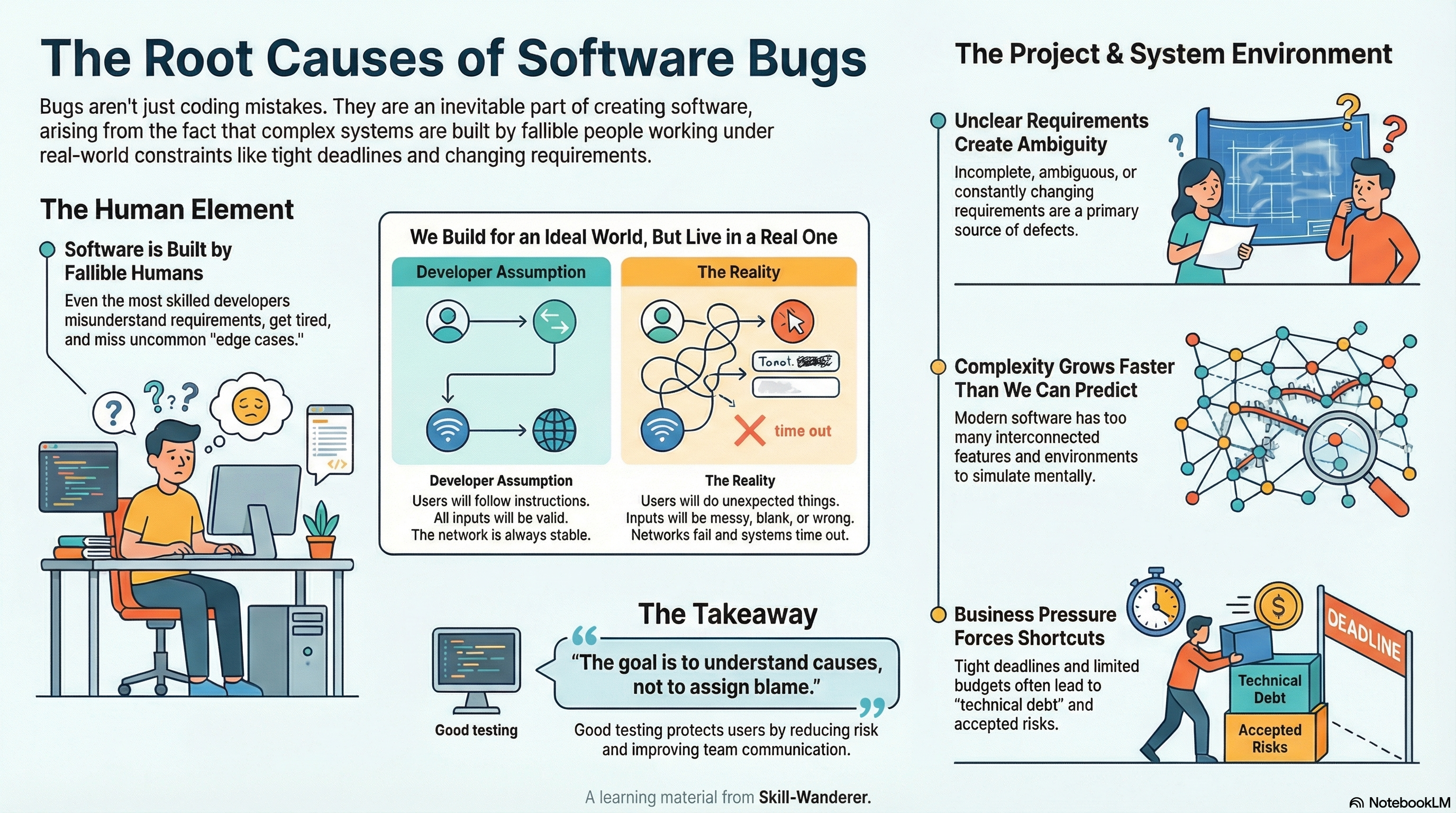
The goal of testing is not to blame individuals, but to understand why bugs happen. By understanding the root causes, we can find them earlier and reduce their negative impact on the business.
2. Software Is Built by Humans
At its core, software is written by people, and people are fallible.
Humans naturally:
-
Misunderstand complex requirements.
-
Make assumptions based on their own experiences.
-
Miss "edge cases" (uncommon scenarios).
-
Get tired, stressed, or rushed.
Note: Even highly skilled senior developers create bugs. Skill reduces the frequency of bugs, but it does not eliminate them.
3. Unclear or Changing Requirements
One of the biggest sources of bugs is the documentation (or lack thereof) before a single line of code is written.
Common Problems:
-
Incomplete: Vital details are missing.
-
Ambiguous: The text can be interpreted in two different ways.
-
Volatile: Requirements change halfway through development.
-
Misalignment: The business stakeholders expect something different than what was written down.
Example Scenario:
Requirement: "The system should send a notification."
Questions a Tester must ask:
-
When? (Immediately? Daily digest?)
-
To whom? (Admin? User? Both?)
-
By what channel? (Email, SMS, In-app?)
-
What if delivery fails? (Retry? Log error?)
Every unanswered question is a potential bug waiting to happen.
4. Complexity Grows Very Fast
Modern software is rarely simple. It involves:
-
Many interconnected features.
-
Multiple integrations.
-
Various devices and browsers.
-
Diverse user behaviors.
Even simple logic can break when combined with other features. Complexity increases faster than our ability to mentally predict behavior.
Testing exists because no one can mentally simulate the entire system at once.
5. Assumptions vs. Reality
Developers often build software based on "Happy Path" assumptions. Testers must challenge these against reality.
| Developer Assumption | The Reality |
| Users follow instructions. | Users do unexpected, illogical things. |
| Inputs are reasonable. | Inputs are messy, blank, or formatted wrong. |
| Systems behave consistently. | Networks fail; databases lock up. |
| Data is clean. | Data is often corrupted or old. |
The Tester's Mindset: "What happens if this assumption is wrong?"
6. Time Pressure and Business Constraints
Software is built under pressure:
-
Tight deadlines.
-
Limited budgets.
-
Marketing promises.
-
Competitive necessity.
The Result: Shortcuts are taken, testing time is reduced, and "Technical Debt" accumulates. Often, bugs are known but accepted as a calculated risk to meet a deadline.
7. Environment & Integration Challenges
Software rarely runs in a vacuum. It must survive in a messy world.
A. Environment Differences
A feature working on a developer's high-end laptop might fail on:
-
Browsers: Chrome vs. Safari vs. Firefox.
-
Devices: High-end iPhone vs. budget Android.
-
OS: Windows vs. macOS vs. Linux.
-
Network: Fast Wi-Fi vs. spotty 4G.
B. Integrations
Modern systems connect to Payment Gateways, Email Services, Maps, and Third-party APIs. Each connection point adds latency and potential failure.
Insight: Many bugs appear between systems, not inside them.
8. Why Testers Are Essential
Because bugs exist due to human error, ambiguity, complexity, pressure, and assumptions, testers are the necessary counterbalance.
Testers exist to:
-
Challenge assumptions.
-
Ask uncomfortable questions.
-
Explore risky behavior.
-
Represent the real user.
Testing is not about distrusting developers—it is about protecting users.
9. 📝 Key Takeaways for Learners
-
Bugs are inevitable; they are not a sign of failure.
-
Most bugs come from process and communication issues, not "bad coding."
-
Good testing reduces risk, not ego.
-
Testers look for causes, not blame.
Last modified: Wednesday, 7 January 2026, 7:41 AM