
Completion requirements
💡
Choose Your Learning Material
This the lesson is available in multiple formats The content is the same—feel free to choose the one way that fits your current learning environment. You do not need to complete all
VIDEO VERSION:
PODCAST VERSION:
SLIDE VERSION:
READING VERSION:
1. What Does “Production” Mean?
"Production" (or "Live") is the environment where real users interact with the software. It is the final destination of the code.
When a bug reaches production:
-
Real customers see it.
-
Real money is involved.
-
Company reputation is at risk.
-
Fixing it becomes significantly more expensive.
Key Insight: A bug in development is a technical problem. A bug in production is a business problem.
2. The Bug Cost Curve (Key Concept)
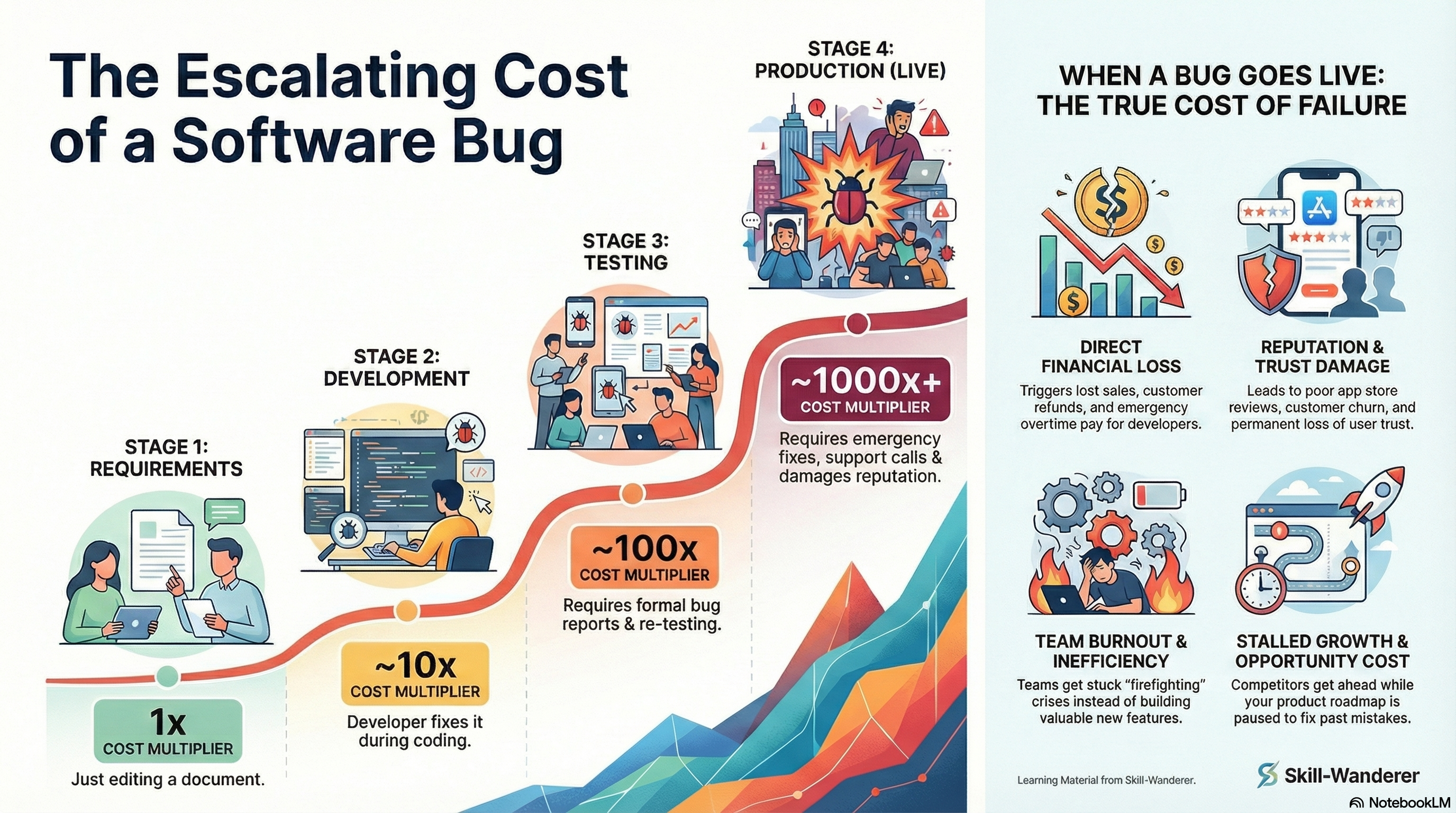
One of the most important economic principles in software development is that the later a bug is found, the more expensive it is to fix.
| Stage Found | Cost Impact | Why? |
| Requirements | Very Low | Just editing a document. |
| Development | Low | Developer fixes it while coding. |
| Testing | Medium | Requires re-testing and bug reporting. |
| Production | Very High | Requires hotfixes, downtime, support calls, and PR damage control. |
The Multiplier Effect: A bug that costs $1 to fix during the design phase can cost 10x to 100x more if it reaches production.
3. Financial Costs
Production bugs hit the bottom line directly.
-
Lost Sales: If the "Checkout" button fails, revenue stops immediately.
-
Refunds & Compensation: Paying users back for failed services.
-
Revenue Leakage: Incorrect calculations (e.g., undercharging for a subscription) can quietly drain money for weeks before being noticed.
-
Emergency Fixes: Paying developers overtime to fix critical issues on weekends.
4. User Trust & Reputation Damage
In the digital age, users are unforgiving.
-
Data Loss: Losing user work is often a permanent trust-breaker.
-
Security Leaks: Exposing private data leads to lawsuits and news headlines.3
-
Broken Core Features: If a banking app won't transfer money, users switch banks.
The Impact:
-
Poor App Store reviews.
-
Negative social media exposure.
-
Customer Churn (Users leaving for a competitor).
Note: Users don’t care why a bug exists (e.g., "The API was down"). They only care that it exists. Rebuilding trust is much harder than fixing code.
5. Operational & Team Costs
The cost isn't just external; it hurts the internal team, too.
-
Firefighting: Instead of building new features, the team is stuck investigating logs and patching holes.
-
Context Switching: Developers have to stop their current work to fix the production bug, breaking their flow and focus.
-
Burnout: Constant emergencies lead to stress and high employee turnover.
6. Opportunity Cost (Hidden but Critical)
This is the cost that does not appear on a balance sheet, but it kills growth.
While the team is busy fixing production bugs:
-
New features are delayed.
-
The product roadmap stalls.
-
Competitors move faster and capture the market.
Opportunity Cost = The value of the work you could have done if you weren't fixing bugs.
7. Technical Debt Growth
When fixing a bug in production, teams often rush.
-
They skip refactoring (cleaning up code).
-
They add "quick fixes" or conditional logic ("If user is X, do Y").
-
They bypass standard testing procedures to get the fix out fast.
This increases Technical Debt—making the code messier, harder to read, and more likely to break again in the future. Untested software ages badly.
8. Real-World Examples
-
Banking: An app shows a user's balance as $0.00 due to a display error (causes panic).
-
E-commerce: A discount code allows 100% off instead of 10% off (direct revenue loss).
-
Mobile: An app crashes immediately after an OS update (users uninstall).
-
Access: A login system locks out valid users (stops all usage).
Most of these high-impact issues could be caught with basic manual testing.
9. Why Businesses Invest in Testing
Smart organizations do not view testing as an "expense"—they view it as insurance.
They test to:
-
Save money in the long term.
-
Protect their brand image.
-
Reduce stress on their engineering teams.
-
Release with confidence.
Quality is cheaper than chaos.
10. 📝 Key Takeaways for Learners
-
Production bugs are expensive: The cost increases exponentially over time.
-
Testing saves money: It is a high-ROI (Return on Investment) activity.
-
Reputation matters: Trust is hard to gain and easy to lose.
-
Manual testing prevents business risk: You are the gatekeeper protecting the business from chaos.
Last modified: Wednesday, 7 January 2026, 8:55 PM