
Completion requirements
💡
Choose Your Learning Material
This the lesson is available in multiple formats The content is the same—feel free to choose the one way that fits your current learning environment. You do not need to complete all
VIDEO VERSION:
PODCAST VERSION:
SLIDE VERSION:
READING VERSION:
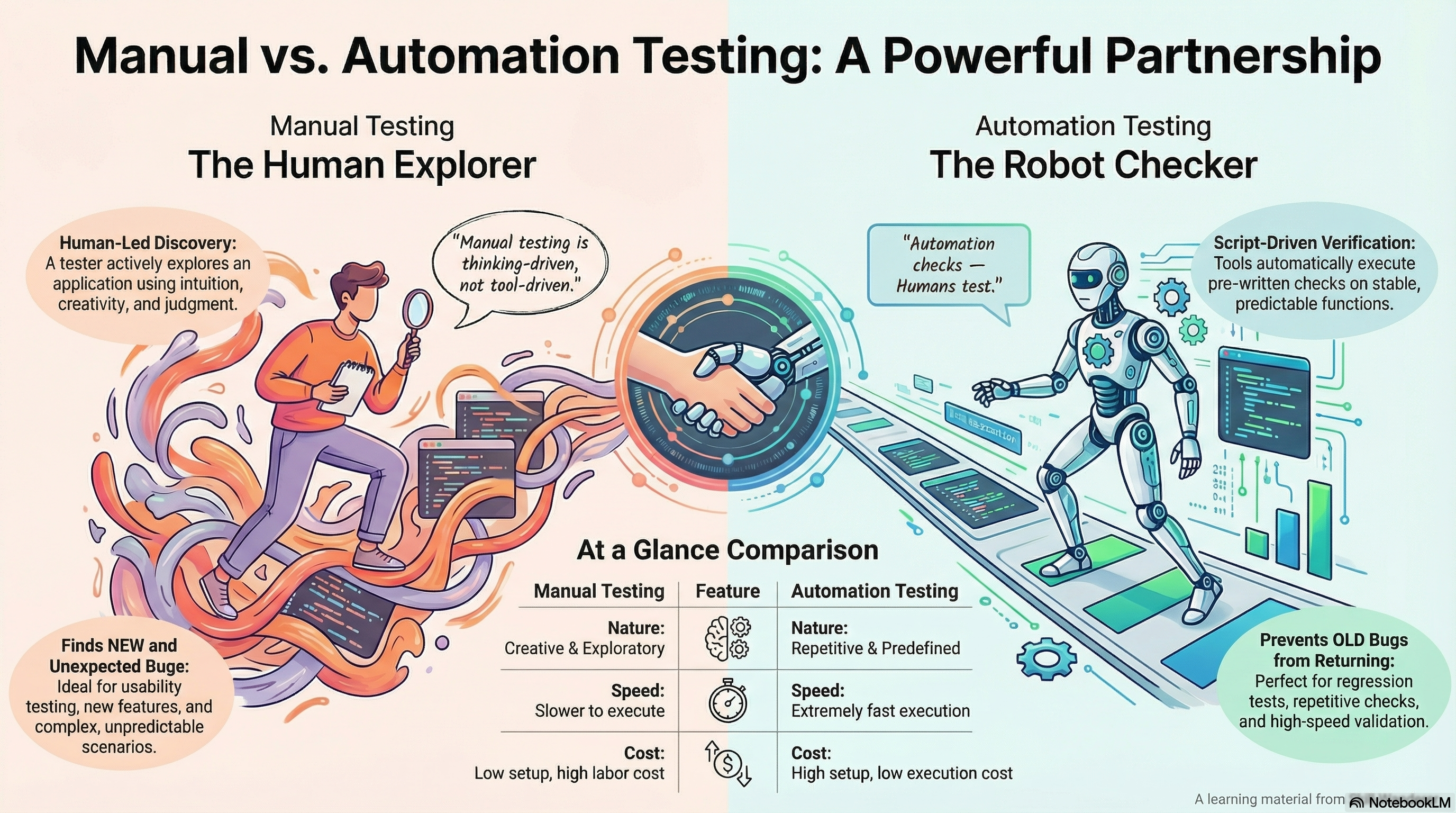
1. The Biggest Misconception
Many beginners start their journey believing:
"Automation testing replaces manual testing."
This is wrong.
-
✅ Automation does not replace manual testing.
-
✅ Manual and automation testing serve different purposes.
-
✅ Strong teams use both together.
2. What Is Manual Testing?
Manual testing is the process where a human tester:
-
Executes test scenarios by hand.
-
Observes system behavior directly.
-
Thinks critically and explores the application.
-
Uses human judgment, intuition, and curiosity.
Focus areas for Manual Testing:
-
Exploratory Testing: "What happens if I try this?"
-
Usability: "Is this button too small?" or "Is this flow confusing?"
-
Edge Cases: Testing weird inputs and unusual scenarios.
-
New Features: Testing code that has just been written.
Key Concept: Manual testing is thinking-driven, not tool-driven.
3. What Is Automation Testing?
Automation testing involves using scripts, tools, and code to:
-
Execute predefined test steps.
-
Repeat tests quickly and frequently.
-
Check stable, predictable behavior.
Focus areas for Automation:
-
Regression Tests: Ensuring old features still work after new changes.
-
Repetitive Checks: Running the same login check 500 times.
-
Large Test Suites: Running thousands of tests in minutes.
-
CI/CD Pipelines: Automatic checks whenever a developer saves code.
Key Concept: Automation checks — Humans test.
4. Key Differences at a Glance
| Feature | Manual Testing | Automation Testing |
| Who does it? | Humans (Testers/Users). | Scripts & Tools. |
| Nature | Flexible, Creative, Exploratory. | Rigid, Predefined, Repetitive. |
| Goal | To find new bugs and understand the system. | To detect regression (known issues). |
| Speed | Slower to execute. | Very fast execution once built. |
| Cost | Low setup cost / High long-term labor. | High initial cost / Low execution cost. |
5. When Manual Testing Is Better
You cannot automate everything. Manual testing is superior when:
-
The feature is new: You can't write a script for something that doesn't exist or isn't stable yet.
-
Requirements are unclear: Humans can adapt; scripts cannot.
-
UI/UX matters: A script can check if a button exists, but only a human can tell if it's misaligned or ugly.
-
Complex Business Logic: Scenarios that require judgment or external knowledge.
-
Ad-hoc / Exploratory: When you just want to "break" the app by trying random things.
Rule of Thumb: New features should always be manually tested first.
6. When Automation Testing Is Better
Automation is a force multiplier. It works best when:
-
Features are stable: The code isn't changing every day.
-
Repetition is high: You need to run the same test on every deployment.
-
Speed is critical: You need feedback in 5 minutes, not 5 hours.
-
Data-Driven Testing: Testing the same form with 1,000 different data sets.
Typical Candidates for Automation:
-
Login/Logout functionality.
-
"Smoke Tests" (Critical path checks).
-
Regression suites.
7. Why Automation Alone Fails
Automation is dumb. It does exactly what it is told, and nothing more.
-
It cannot think.
-
It cannot notice "this feels wrong."
-
It cannot explore creatively.
-
Blindness: If a button turns invisible but is still technically "clickable" in the code, automation might pass the test, while a human would fail it immediately.
"If a bug was never imagined, it will never be automated."
You cannot automate what you don’t yet understand.
8. The Correct Testing Strategy (Industry Reality)
Professional teams do not choose one over the other. They follow a cycle:
-
Manual Testing: Explores and understands the system to find bugs in new features.
-
Identify: Crucial, stable behaviors are identified as candidates for automation.
-
Automate: Scripts are written to "protect" those behaviors from breaking in the future.
-
Repeat: Manual testers move on to explore new risks and features.
Manual testing never disappears—it just evolves.
9. Career Reality for Beginners
-
Automation requires coding: To be an automation engineer, you essentially need to be a developer.
-
Manual testing builds foundations: You cannot write good automation scripts if you don't know how to test.
-
The Career Path: Good manual testers often become:
-
Senior QA Leads (Strategy focus).
-
Test Managers.
-
Automation Engineers (Technical focus).
-
Product Owners (Business focus).
-
Manual testing is not a dead-end—it is the entry point to quality engineering.
10. 📝 Key Takeaways for Learners
-
Manual ≠ Outdated. It is a thinking skill.
-
Automation ≠ Superior. It is a checking tool.
-
Manual Testing finds new problems (Discovery).
-
Automation Testing prevents old problems (Regression).
-
Quality comes from strategy, not just tools.
Last modified: Wednesday, 7 January 2026, 9:42 PM