
Completion requirements
💡
Choose Your Learning Material
This the lesson is available in multiple formats The content is the same—feel free to choose the one way that fits your current learning environment. You do not need to complete all
VIDEO VERSION:
PODCAST VERSION:
SLIDE VERSION:
READING VERSION:
1. Why This Topic Matters
One of the most confusing topics for beginners is understanding the boundaries of their role.
"Which type of testing am I actually doing?"
Understanding these three concepts helps you:
-
Know your role: Stop worrying about code if you don't need to.
-
Avoid unrealistic expectations: Don't try to fix the engine if you're just testing the brakes.
-
Build the right skills first: Focus on user behavior before system architecture.
-
Communicate better: Speak the same language as developers.
2. Black Box Testing
"The User's Perspective"
What It Is
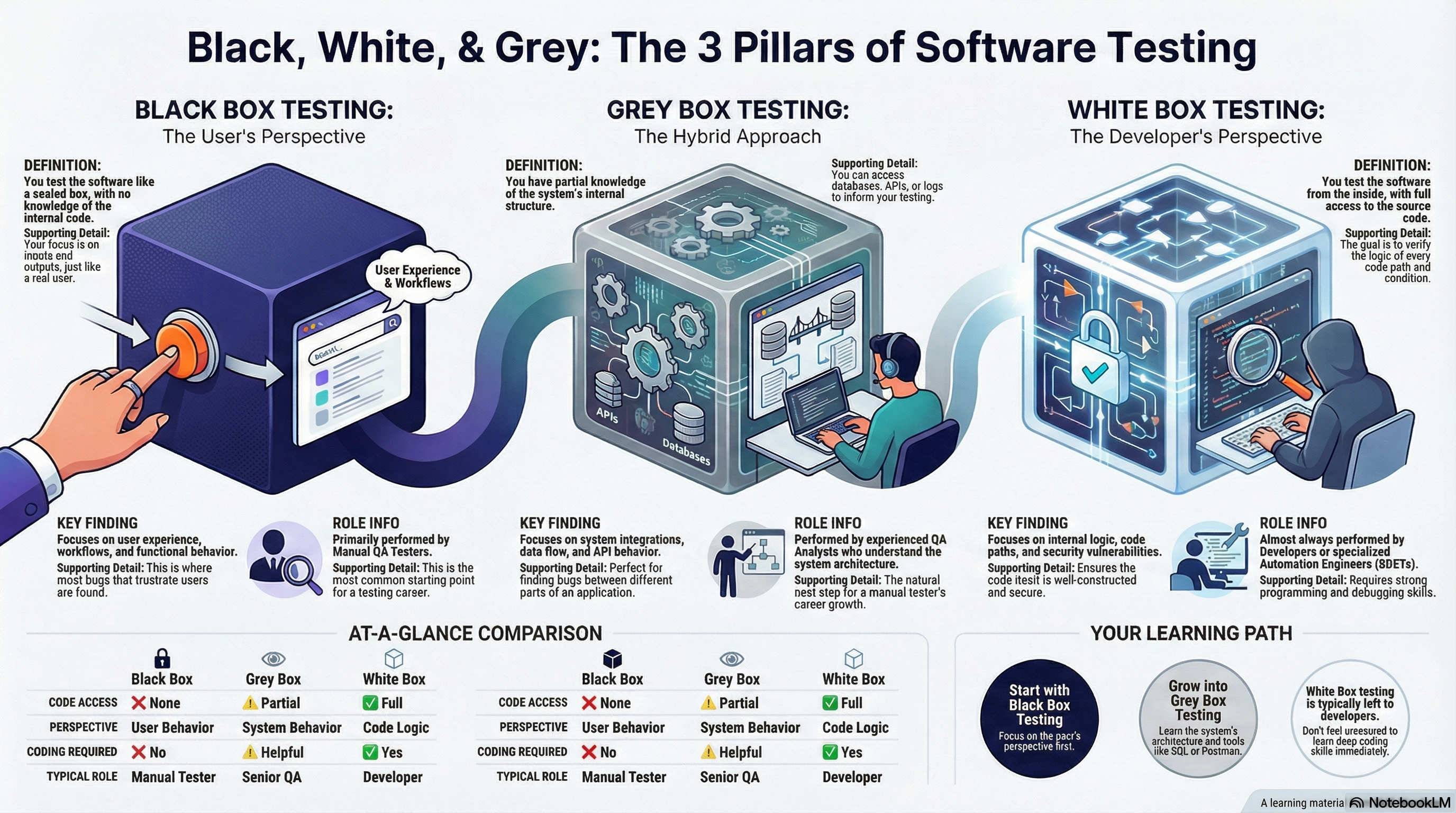
In Black Box testing, you treat the software like a sealed box.
-
You do not see the internal code or structure.
-
You test entirely from the user's perspective.
-
You focus only on Inputs (what goes in) and Outputs (what comes out).
The Mindset: "I don't know how it works inside, and I don't care. I only care how it behaves."
What You Focus On
-
Functional behavior (Does it do what it says?)
-
UI and UX (Is it easy to use?)
-
Business rules.
-
Error handling (Does it crash gracefully?)
-
Edge cases and User workflows.
Example
You enter a valid username and password into a login screen. You check if you are redirected to the Dashboard. You do not check the database query or the encryption algorithm used.
Skills Needed
-
Logical thinking.
-
Curiosity.
-
Attention to detail.
-
Understanding requirements.
-
Exploratory mindset.
👉 Most manual testers start their careers primarily in Black Box testing.
3. White Box Testing
"The Developer's Perspective"
What It Is
In White Box testing (also called "Glass Box" or "Clear Box"), you test the system from the inside.
-
You have full access to the source code.
-
You have deep knowledge of the internal logic.
-
Your tests are based on the code structure itself.
What You Focus On
-
Code paths (Did I test every line?).
-
Branch logic (Did the
ifand theelseboth work?). -
Loops and conditions.
-
Internal security and error handling.
Example
A developer writes a test to ensure that a specific function calculates tax correctly for all 50 states by looking at the switch statement in the code.
Skills Needed
-
Programming / Coding.
-
Understanding algorithms.
-
Debugging skills.
-
Unit Testing frameworks.
👉 White Box testing is usually performed by Developers or Automation Engineers.
4. Grey Box Testing
"The Hybrid Approach"
What It Is
Grey Box testing sits in the middle. You don't have full access to the code, but you aren't flying blind either.
-
You have partial knowledge of the system internals.
-
You have access to Logs, APIs, or Databases.
-
You know enough to test smarter, but you aren't rewriting the application.
What You Focus On
-
API behavior (Request/Response).
-
Database effects (Did the data actually save?).
-
System integrations.
-
Security and data flow.
Example
You submit a "Contact Us" form (Black Box action), but then you query the Database to make sure the user's email was actually recorded in the users table (Grey Box verification).
Skills Needed
-
System understanding (Architecture).
-
Reading server logs.
-
Using tools like Postman (API testing) or SQL (Database).
👉 Many experienced manual testers naturally evolve into Grey Box testers as they learn the system.
5. Side-by-Side Comparison
| Aspect | Black Box | Grey Box | White Box |
| Code Access | ❌ None | ⚠ Partial (Logs/DB) | ✅ Full |
| Perspective | User Behavior | System Behavior | Code Logic |
| Requires Coding? | ❌ No | ⚠ Helpful (SQL/API) | ✅ Yes |
| Best For | UX, Workflows, Functions | Integrations, Data, APIs | Logic, Paths, Security |
| Typical Role | Manual Tester / UA | Senior QA / Analyst | Developer / SDET |
6. Common Beginner Mistakes
-
❌ Myth: "Manual testers must do white box testing."
-
Reality: No, that is mostly the developer's job (Unit Testing).
-
-
❌ Myth: "Black box testing is simple and low value."
-
Reality: Black box testing finds the bugs that actually annoy users. It is high value.
-
-
❌ Myth: "If I don't code, I'm not a real tester."
-
Reality: Critical thinking is your primary tool; code is secondary.
-
7. Real Industry Flow
In a healthy team, all three exist together:
-
White Box: Developers test the logic as they write it.
-
Grey Box: Testers verify that the API and Database talk to each other correctly.
-
Black Box: Testers verify the final experience works for the user.
8. 📝 Key Takeaways for Learners
-
Black Box = User-focused testing (Start here).
-
White Box = Code-focused testing (Leave this to devs for now).
-
Grey Box = System-aware testing (Grow into this).
-
Most user-impacting bugs are found via Black Box testing.
-
Your career path is likely: Black Box ➝ Grey Box.
Last modified: Thursday, 8 January 2026, 2:17 PM