
Completion requirements
💡
Choose Your Learning Material
This the lesson is available in multiple formats The content is the same—feel free to choose the one way that fits your current learning environment. You do not need to complete all
VIDEO VERSION:
AUDIO VERSION:
SLIDE VERSION:
READING VERSION:
1. Defining Quality Assurance (QA)
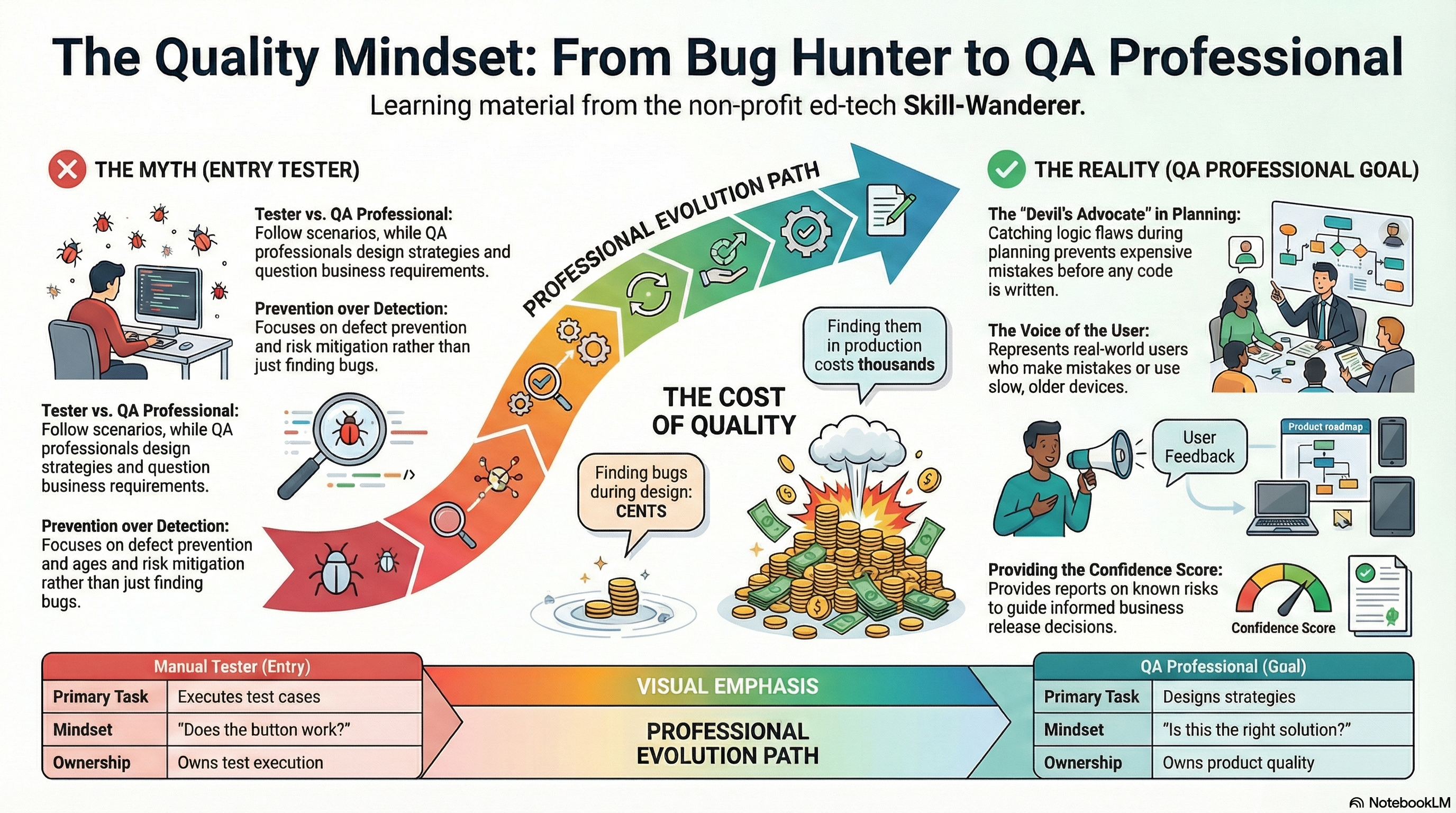
Quality Assurance is the strategic discipline of ensuring a software product meets user expectations, fulfills business requirements, and maintains high reliability.
-
❌ The Myth: QA is just "finding bugs" at the end of a project.
-
✅ The Reality: QA is about defect prevention, risk mitigation, and protecting the end-user experience.
QA Focus Areas:
-
Correctness: Does it do what the business intended?
-
User Experience (UX): Is it intuitive and accessible?
-
Stability: Does it work consistently under different conditions?
-
Risk Reduction: Identifying "what could go wrong" before the code is even written.
2. Course Roadmap: Black Box & Manual Testing
This course focuses on Black Box Testing—the art of testing software without looking at the internal code.
Our Learning Objectives:
-
Mastering the "User Perspective."
-
Identifying real-world edge cases and risks.
-
Reporting defects with professional clarity and impact analysis.
Target Outcome: We aren't just training you to follow instructions; we are training you to think and act like a QA professional.
3. Tester vs. QA: Evolution of the Role
While the terms are often used interchangeably, there is a significant professional evolution between them:
| Feature | The Manual Tester (Entry Point) | The QA Professional (The Goal) |
| Primary Task | Executes test cases and follows scenarios. | Designs strategies and questions requirements. |
| Focus | Finds and reports defects (Bugs). | Analyzes risks and prevents defects. |
| Mindset | "Does the button work?" | "Is this the right solution for the user?" |
| Ownership | Owns the execution of the test. | Owns the quality of the product. |
Note: We will dive deeper into this distinction in the next lesson.
4. Why QA is Critical (The Business Case)
Without a dedicated QA presence, teams fall into a "firefighting" loop.
-
Cost Efficiency: Finding a bug during the design phase costs cents; finding it in production costs thousands.
-
User Trust: A single major bug can lead to uninstalls and negative reviews.
-
Velocity: High-quality code allows for faster releases because there is less "re-work" and fewer emergency patches.
5. QA Responsibilities Across the SDLC
A true QA professional is involved from the first meeting to the final release.
🧠 Phase 1: Planning & Requirements
QA acts as the "Devil's Advocate." We ask the hard questions:
-
"What if the user's internet drops during payment?"
-
"What if they try to upload a 2GB file instead of a 2MB one?"
-
Goal: Catch logic flaws before a single line of code is written.
🛠 Phase 2: During Development
QA collaborates with Developers to clarify Acceptance Criteria. By preparing tests early, we ensure that the "Definition of Done" actually means the feature is stable.
🧪 Phase 3: The Testing Phase (Black Box)
This is where your core technical skills come to life through:
-
Functional Testing: Checking specific features.
-
Exploratory Testing: Using intuition to find "unplanned" bugs.
-
Regression Testing: Ensuring new changes didn't break old features.
🚀 Phase 4: Release & Beyond
QA provides the Confidence Score. We don't just "approve" a release; we provide a report of known risks so the business can make an informed "Go/No-Go" decision.
6. The "Voice of the User"
Developers often suffer from "Developer Vision"—they know how the app is supposed to work. QA represents the real world.
QA considers users who:
-
Are non-technical or in a rush.
-
Use older devices or slow 3G networks.
-
Make mistakes (double-clicking, hitting "back" during a save).
The Difference: A Developer thinks about how it should work. A QA thinks about how it will be used.
7. Our Philosophy: Growth Mindset
You will start by learning the mechanics of manual testing. However, the ultimate goal of this course is to build your Quality Mindset.
-
Phase 1: Learn to observe and report.
-
Phase 2: Learn to analyze and investigate.
-
Phase 3: Learn to advocate for the user and the product.
8. Key Takeaways
-
Black Box Testing is our primary tool for this course.
-
Testing is a task; QA is a mindset of ownership.
-
Early involvement is the key to preventing expensive mistakes.
-
A great QA is the strongest bridge between the user and the developer.
Last modified: Thursday, 22 January 2026, 7:47 AM