
Completion requirements
💡
Choose Your Learning Material
This the lesson is available in multiple formats The content is the same—feel free to choose the one way that fits your current learning environment. You do not need to complete all
VIDEO VERSION:
AUDIO VERSION:
SLIDE VERSION:
READING VERSION:
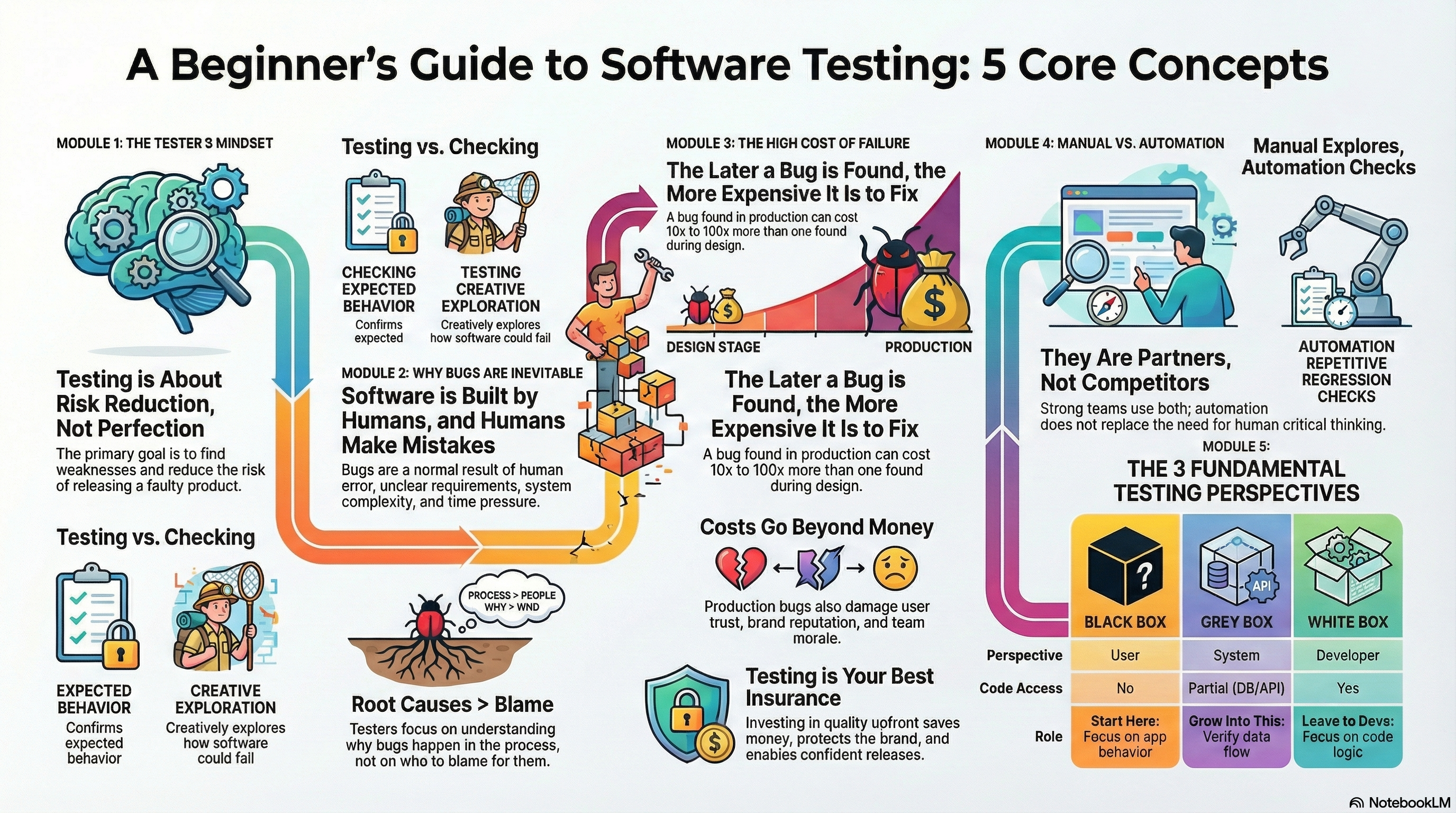
Introduction to Software Testing
Software testing is an analytical process of evaluating a product to determine if it meets requirements, satisfies user expectations, and reveals defects or risks.
Contrary to common misconceptions, testing is not merely about "finding bugs" or "clicking around"; it is a professional thinking skill that serves as a bridge between developer intent and user reality.
1. The Core Philosophy of Software Testing
The primary objective of testing is to reduce risk to an acceptable level, not to prove that a system is perfect or bug-free. Testing provides stakeholders with confidence in a product's quality and protects the business from financial and reputational damage.
The Distinction Between Testing and Checking
A critical concept for professional testers is the difference between "checking" a system and "testing" it.
| Feature | Checking | Testing |
|---|---|---|
| Goal | Confirming expected behavior. | Exploring unexpected behavior. |
| Question | "Does this work?" | "How could this fail?" |
| Nature | Repetitive and mechanical. | Analytical and creative. |
| Automation | Highly suitable for automation. | Best performed by human testers. |
Key Insight: Manual testers provide value through Testing—exploration and analysis—rather than just "Checking" or simple verification.
2. The Root Causes of Software Bugs
Bugs are an inevitable byproduct of software development because software is built by humans. Understanding why bugs occur is essential for finding them early:
- Incomplete or Changing Requirements: Every unanswered question in a requirement document is a potential bug.
- Rapidly Growing Complexity: Modern systems involve interconnected features too complex for one person to mentally simulate.
- Assumptions vs. Reality: Developers often focus on "Happy Path" scenarios; testers must challenge these assumptions.
- Environment and Integration Challenges: Software may work on a high-end laptop but fail on budget devices or spotty networks.
- Business Constraints: Tight deadlines lead to "Technical Debt," where bugs are known but accepted as risks.
3. The Economics of Software Failure
Organizations view testing as strategic insurance. The economic impact of a defect increases exponentially depending on when it is discovered.
The Bug Cost Curve
The later a bug is found, the more expensive it is to fix. A defect that costs $1 during design can cost 10x to 100x more in production.
- Requirements Stage: Very low cost (editing a document).
- Development Stage: Low cost (fixed while coding).
- Testing Stage: Medium cost (requires re-testing and reporting).
- Production Stage: Very high cost (requires hotfixes and damage control).
The Business Impact of Production Bugs
A bug in production is a business problem, not just a technical one.
- Direct Financial Loss: Lost sales and revenue leakage.
- Reputation Damage: Rebuilding trust is harder than fixing code.
- Opportunity Cost: Teams "firefighting" bugs cannot build new features.
4. Testing Methodologies: Black, Grey, and White Box
Testing is categorized by the level of access a tester has to the internal code.
| Aspect | Black Box | Grey Box | White Box |
|---|---|---|---|
| Perspective | User (Behavior) | System (Integration) | Developer (Logic) |
| Code Access | None | Partial (Logs/APIs) | Full |
| Focus | UI, UX, Workflows | Data flow, APIs, SQL | Code paths, Loops |
| Requirement | Critical Thinking | System Architecture | Programming Skills |
5. Manual vs. Automation Testing Strategy
Automation is a "force multiplier" that acts as a checking tool, while manual testing is a discovery tool.
Manual Testing (Discovery)
- Best for new features, UI/UX assessments, and exploratory testing.
Automation Testing (Regression)
- Best for regression testing, repetitive tasks, and checking stable features.
Industry Reality: "Automation is dumb"—it only does what it is told. If a bug was never imagined by the human creator, it will never be automated.
6. Professional Takeaways
- Testing is a Thinking Skill: Success requires curiosity and attention to detail.
- Quality is Cheaper than Chaos: Early testing saves money and reduces burnout.
- Manual Testing is a Foundation: Essential before moving to automation.
- The Goal is a Safe Release: Testing aims for risk reduction, not perfection.
Last modified: Saturday, 17 January 2026, 9:50 AM