Waterfall vs. Agile: A Guide for Black Box Testers
This lesson is available in multiple formats. The content is the same — feel free to choose the one that fits your current learning environment. You do not need to complete all.
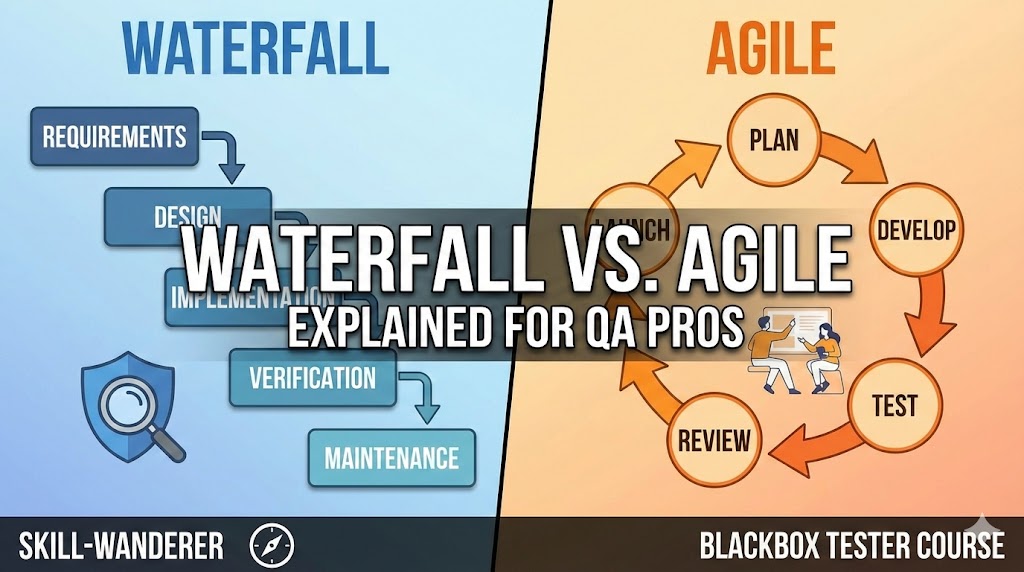
1. Introduction: Why the Development Model Matters
Black box testing focuses on what the system does (inputs → outputs), ignoring internal code structure. However, the software development lifecycle (SDLC) model dictates when you test, how you communicate, and what artifacts you create.
👉 Why this matters to you:
- Timing: In Waterfall, you might wait months to test. In Agile, you test on Day 2 of a sprint.
- Documentation: Waterfall requires detailed proof (Step-by-step Test Cases). Agile prizes speed and intuition (Checklists/Exploratory).
- Job Role: A Waterfall tester is often a "gatekeeper." An Agile tester is a "collaborator."
2. The Waterfall Model
What is it?
Waterfall is a linear, sequential approach. Imagine a real waterfall; water flows down and cannot easily flow back up. A phase must be 100% complete and "signed off" before the next one starts.
Typical Phases & The Tester's Role
- Requirements: Tester reviews requirements for testability.
- Design: Tester plans the strategy.
- Implementation/Coding: Tester writes detailed scripts.
- Testing: The "Testing Phase" officially begins here.
- Deployment & Maintenance.
Waterfall from a Black Box Tester's View
- Source of Truth: The Requirements Document (BRD/SRS). If the software behaves differently than the document, it is a bug—even if the software is "better."
- Artifacts: Heavy emphasis on formal Test Plans, Traceability Matrices (RTM), and detailed Test Cases with pre-conditions and post-conditions.
- Bug Fixing: Bugs found here are expensive because the code was written weeks or months ago.
💡 Real-World Scenario: The Banking System
You are testing a core banking mainframe update.
- Why Waterfall? Regulations require a paper trail for every change. Errors can cost millions or result in lawsuits.
- Your Job: You spend 4 weeks writing test cases based on a 200-page specification document before you ever see the software.
Pros & Cons for Testers
| Pros | Cons |
|---|---|
| Clear expectations (Expected Results are documented). | Boring "waiting periods" during coding. |
| Easy to track progress (RTM). | "Crunch time" pressure: Development delays eat into Testing time. |
| Stable requirements (scope creep is managed). | If a requirement was misunderstood early on, you won't catch it until the very end. |
3. The Agile Model
What is it?
Agile is iterative and incremental. Instead of building the whole car at once, you build a skateboard, then a scooter, then a bike, then a car. Development happens in short cycles called Sprints (usually 2 weeks).
Key Concepts for Testers
- User Stories: Requirements are small, user-focused sentences (e.g., "As a user, I want to reset my password so I can regain access").
- Acceptance Criteria (AC): The specific conditions the Black Box tester must verify to pass the story.
- Definition of Done (DoD): The checklist that proves a task is truly finished (e.g., "Code written, Tested, No critical bugs").
Agile from a Black Box Tester's View
- Source of Truth: The User Story and conversations with the Product Owner.
- Artifacts: Lightweight. Mind maps, checklists, one-page test strategies, and automated regression scripts.
- Timing: Testing happens concurrently with coding. You might test a feature on Tuesday that was coded on Monday.
💡 Real-World Scenario: The Social Media App
You are testing a new "Stories" feature for a startup.
- Why Agile? Market trends change fast. They need to release something next week to beat a competitor.
- Your Job: You don't have a heavy spec document. You talk to the designer and developer, agree on how it should work, and run exploratory tests immediately.
Pros & Cons for Testers
| Pros | Cons |
|---|---|
| You find bugs immediately (cheaper to fix). | Documentation is often scarce or outdated. |
| You influence the design early. | Regression testing burden is high (re-testing old features every 2 weeks). |
| Constant collaboration (less loneliness). | Requirements can change mid-sprint. |
4. High-Level Comparison Cheat Sheet
| Feature | Waterfall | Agile |
|---|---|---|
| Requirement Stability | Fixed (Changes require Change Requests) | Flexible (Changes welcomed) |
| Testing Timing | A distinct phase after coding | Continuous, during coding |
| Tester's Mindset | "Verification" (Does it match the spec?) | "Validation" (Is it useful to the user?) |
| Documentation | Heavy, formal, approved | Lightweight, "Just enough" |
| Team Structure | Silos (Testers sit with Testers) | Cross-functional (Testers sit with Devs) |
| Feedback Loop | Long (Months) | Short (Daily/Weekly) |
5. Impact on Black Box Techniques
The actual techniques (Equivalence Partitioning, Boundary Value, etc.) don't change, but how you apply them does.
In Waterfall: "The Formal Approach"
- Technique: Decision Table Testing.
- Application: You create a complex table mapping every possible input combination from the Specification Document.
- Technique: Boundary Value Analysis.
- Application: You formally document test cases for min, min-1, max, max+1 based on the Requirements Spec.
- Traceability: You must link every Test Case ID to a Requirement ID.
In Agile: "The Rapid Approach"
- Technique: Exploratory Testing.
- Application: You use your domain knowledge to "hunt" for bugs without a script, focusing on new features.
- Technique: Acceptance Test-Driven Development (ATDD).
- Application: You write the test cases (often in Gherkin syntax: Given/When/Then) before the code is written to guide the developer.
- Regression: Heavy reliance on Automation because manual testers cannot re-test the whole system every 2 weeks.
6. Summary for Learners
- Waterfall is about predictability and control. It is document-driven. Testers act as quality gatekeepers at the end.
- Agile is about adaptability and speed. It is conversation-driven. Testers act as quality coaches throughout the process.
🧠 Critical Thinking Note: Most modern companies claim to be "Agile," but many practice "Water-Scrum-Fall" (Agile meetings, but Waterfall requirements and deadlines). A good Black Box tester learns to adapt to the reality of their specific team, regardless of the label.
7. Exam & Interview Prep
Be ready to answer these common questions:
- "How does your test strategy change if we switch from Waterfall to Agile?"
- Answer: "I would shift from writing heavy documentation upfront to focusing on exploratory testing and automation. I would collaborate with developers earlier rather than waiting for a build."
- "Can you use Boundary Value Analysis in Agile?"
- Answer: "Absolutely. The technique is the same, but instead of documenting it in a 50-step test case, I might just add it to the Acceptance Criteria or a quick test checklist."
- "Which model is better?"
- Answer: "Neither is strictly better; it depends on the project. Waterfall is better for safety-critical, stable projects (like medical devices). Agile is better for consumer-facing apps where requirements change often."