There Is No Best Way to Learn, Only a Better One
This lesson is being produced in multiple formats. The lesson itself is the same in each one, so pick whichever suits your context right now. Formats still in production are marked below.

Ask ten people how they learn best, and you will get ten confident answers.
Most people who learn anything seriously end up swearing by one or two methods, and most of them will tell you, quite sincerely, that theirs is the one that works.
Module 1 settled whose job your learning is, and it closed by saying that everything after that is craft. This module is the first piece of that craft: the ways of learning themselves. Before we take them one at a time, this lesson deals with the question that sits underneath all of them. Is there a best way to learn?
There is not. There is only a better way, for one specific situation. I learned that slowly, and mostly by being wrong about it first.
1. Everyone Swears by Something
Listen to people talk about how they learn, and you will start to hear the same few camps.
- The watchers learn from videos and online courses. Why struggle through a dense chapter when someone can show you the whole thing on screen in ten minutes?
- The builders learn by making things. Stop consuming and start building, they say, because one finished project teaches more than a hundred tutorials.
- The readers learn from books. Video is entertainment, they will tell you, and the real thinking is on the page.
- The talkers learn from people. Find someone who actually does the work and ask them, because one conversation beats a month of study.
Here is the part each camp finds hard to accept: all of them are valid. Each of those methods genuinely works, and each of those people really did learn that way. Nobody is lying to you.
Where they go wrong is the step after. They take what worked for them, in their subject, at that point in their life, and turn it into a rule for everyone and everything. A method that worked for you once is evidence. The same method promoted to the one right way for everybody is a habit that has started giving advice.
2. I Used to Be One of Them
Trust me on this, because I used to stand in those camps myself. Several of them, in fact.
At different times I have told people, with complete conviction, that this method or that one was the best way to learn. The method changed over the years. The conviction never did. Each time I had evidence, because each time the method had worked for me, and that felt like the only evidence that mattered.
What changed my mind was not an argument. It was a change of subject.
3. Three Fields, Three Different Answers
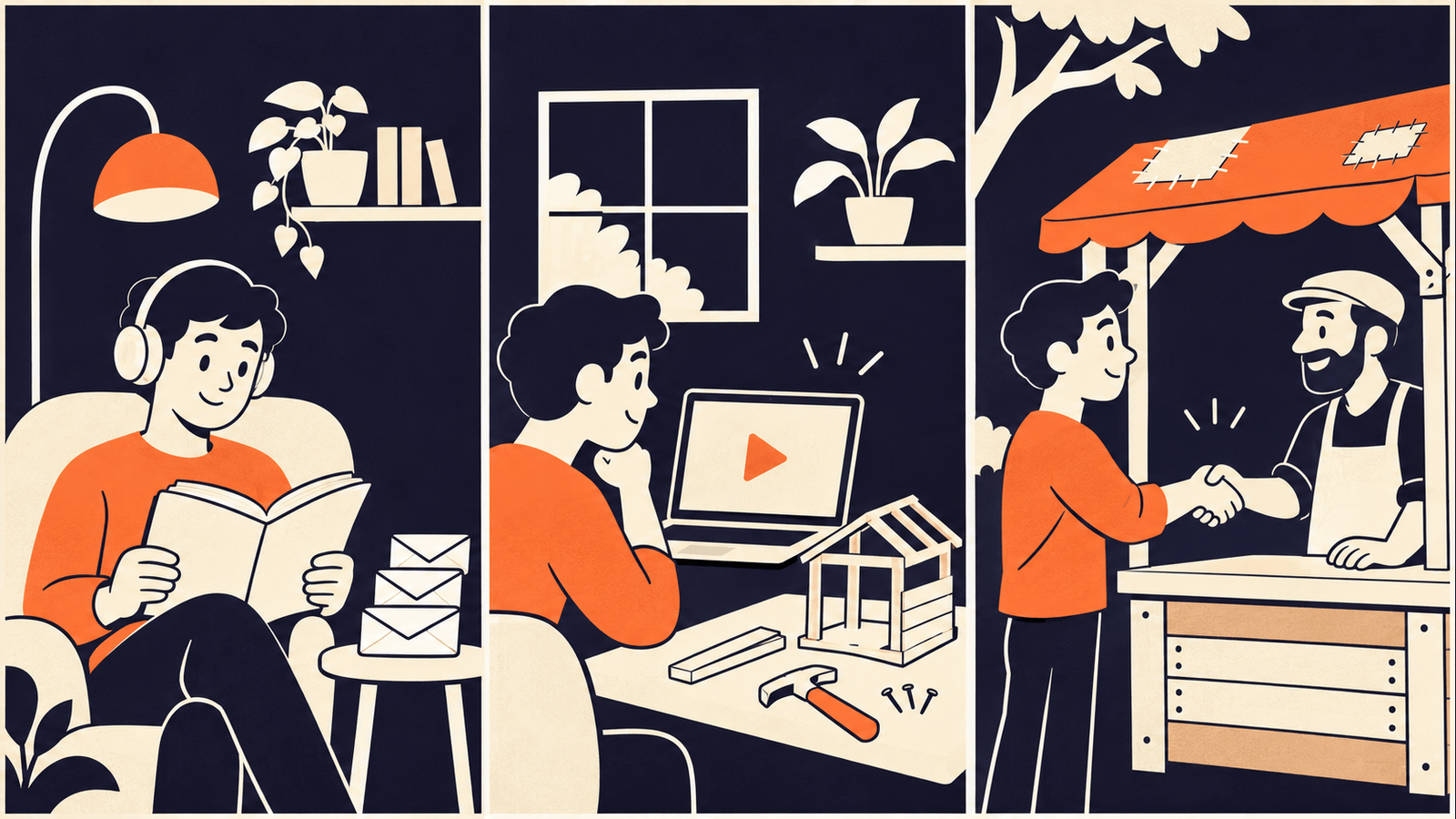
Tech is the field I have told you most about so far, but it was not my first. I started in marketing. Then came tech, and later entrepreneurship. And somewhere along the way it suddenly clicked: every method I had championed came with its own pros and cons, and which of them mattered depended on what I was trying to learn.
Here is how it turned out for me, in the order I learned them.
For marketing, the better way has been reading books and newsletters, and listening to podcasts. The core of marketing is people: what they want, what they fear, and how they decide. That changes slowly, and the best thinking about it has been written down, tested, and argued over for decades, so a good book hands you years of other people's experiments in a few evenings. The surface of marketing is the opposite. Channels, platforms, and whatever is working this quarter all change constantly, and newsletters and podcasts keep you current on that layer, straight from practitioners describing what they are seeing right now. It is the split from the lesson on a changing world again: principles that last decades, underneath practices and tools that keep moving.
Learning by building is not cheap here. A real campaign costs money and weeks, and the result is noisy: when it works, it is often hard to tell whether the message, the timing, or plain luck did it. Learning from campaigns other people have already run is a much cheaper place to start.
For tech, the better way has been courses and videos, followed by making something. So much of tech happens on a screen, which means a video can show you exactly what to do: what to type, where to click, and what you should see when it works. It catches the small steps that a written explanation tends to skip. Tech also gives some of the fastest and cheapest feedback of any field. You can try what you just watched within minutes, on your own machine, for nothing. It either works or it does not, and if you break it, you undo it and try again. That is the opposite of marketing. When building costs almost nothing, it would be strange not to learn by building.
For entrepreneurship, the better way has been trial and error, and there is no beating talking with people in the field. Much of what you need to know in business is not written down anywhere, because it is specific to a market, a customer, a place, or a moment. What will this customer actually pay? Which supplier delivers when they say they will? Why did the last three people who tried this idea give up? No book can answer those for your situation, and the business books that do exist were mostly written by the survivors, about their own markets, at a moment that has already passed. So you learn by trying: launching, selling, getting it wrong, and adjusting. It is slow, and it can be expensive, but the lessons stick in a way nothing else does.
The fastest way to cut that trial and error down is a conversation. Somebody two steps ahead of you can tell you in ten minutes what would take you a year to find out, because they have already paid for those mistakes. In this field, much of the most valuable knowledge lives in people's heads rather than on pages.
Same person, same habits, same brain. Three fields, and three different answers to the question of how to learn best. As you can see, there is no best. There is only better, for one specific situation.
If I had only ever learned one of them, I suspect I would still be telling people I had found the best method.
4. No Best, Only Better
Asking for the best way to learn is like asking for the best vehicle. A bicycle is excellent on a road and useless at sea. A boat is the other way round. Nobody calls a boat a bad vehicle because it failed to climb a mountain. It was simply the wrong choice for the ground.
The question "what is the best way to learn?" hides an assumption: that one answer holds for every subject, every person, and every stage. It does not. The useful question is shorter. Better for what?
Two things decide the answer more than anything else.
The subject, and where its knowledge lives. Every field keeps its knowledge somewhere. In marketing, the lasting part lives in books and the fast-moving part lives with the practitioners who write and talk about it. In tech, a great deal of it lives on screens and in documentation, where you can test it yourself for free. In entrepreneurship, much of it lives in people and in the market itself. The rule that falls out of this is simple: go to where the knowledge lives.
What you actually need to learn. Even inside one subject, different kinds of knowledge call for different methods. Take negotiation. You can read how it works in an evening. Negotiating well is a skill, and skills only come from doing. Knowing when to walk away from a deal is judgement, and judgement comes from experience, either your own or that of someone who has already made those calls. Knowing about something, knowing how to do it, and knowing when to do it are three different things, and no single method gives you all three.
There is one more twist: the answer moves as you progress. At the start of a subject, a book or a course is often the better way in, because it gives you the map and the vocabulary. Conversations with experts often give you less at that stage, because you do not yet know enough to ask a specific question, and specific questions are the ones that get useful answers. Later, the map stops being your problem, and building, trial and error, and conversation become the places where you learn fastest. The same person, in the same field, can find a different method better a year from now.
5. This Is Not About Learning Styles
One misunderstanding is worth heading off here, because it sounds like the same idea and it is not.
You may have heard that each person is a "visual learner", an "auditory learner", or a "hands-on learner", and should learn everything through that one channel. It is a popular idea, and it has been studied a great deal. When researchers have tested it properly, teaching people in their preferred style has not helped them learn more.
This lesson makes a different claim: the method should fit the subject first and the person second. Nobody learns to swim from a book, however much they love reading. Nobody learns how a new language sounds by reading about it.
Your preferences still matter. Module 1 made the case that a method you enjoy is a method you will keep coming back to, and coming back is most of the game. So it helps to keep their jobs separate. Your preferences decide what you will keep doing. The subject decides what will actually teach you. When the two pull in different directions, you do not have to choose between them. Combining methods is how you get both, and it is where this module ends up.
6. What the Rest of This Module Covers
Back in Module 1, the lesson on why teaching yourself is more productive and more fun ended on a claim: there is no best method, only the mix that fits you. This module is where that claim gets earned.
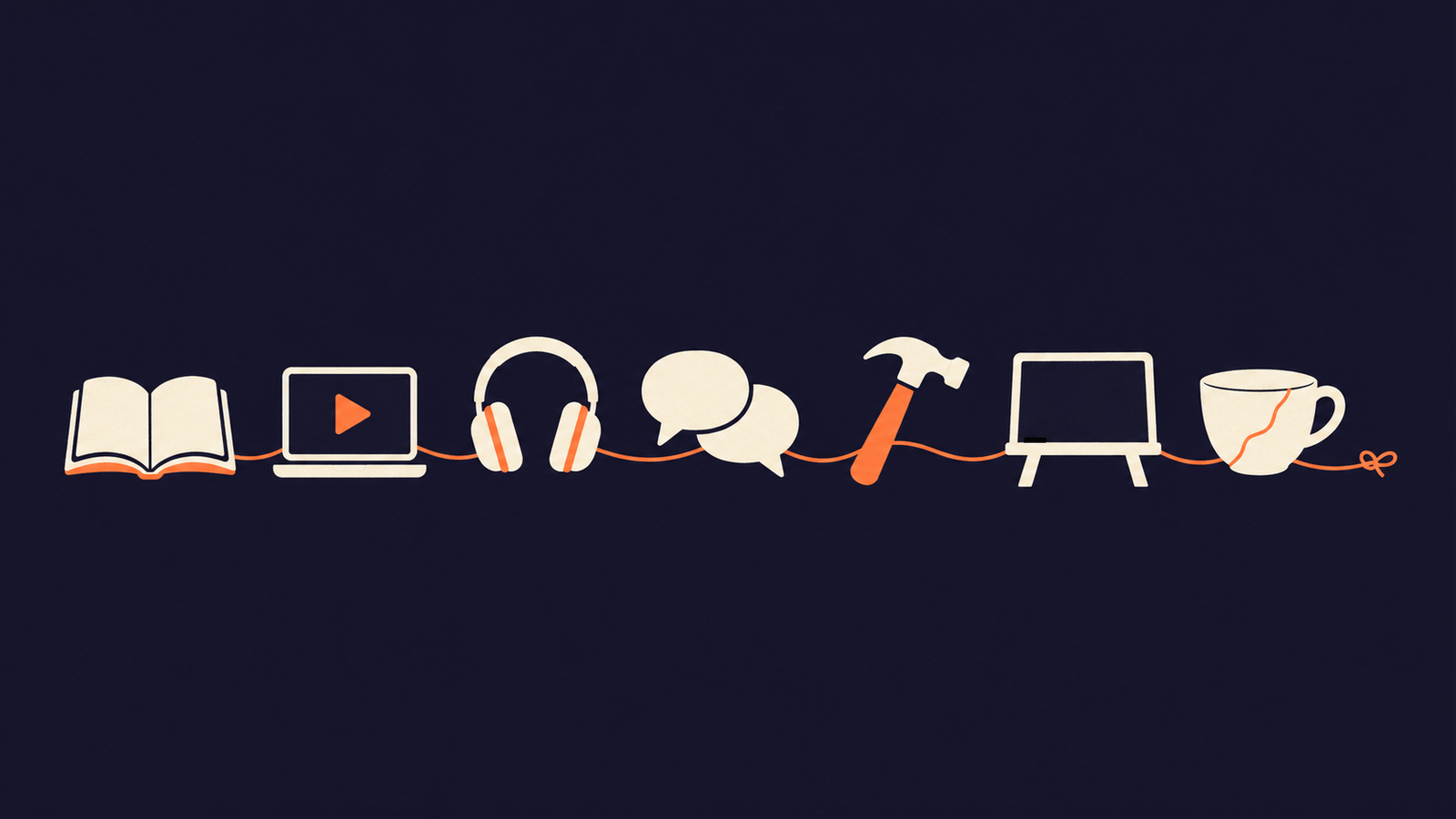
That lesson gave each way of learning a few lines. Here, each one gets a lesson of its own and a fair hearing: what it is genuinely good at, where it quietly lets you down, and the situations in which it is the better choice. The methods covered are:
- Reading: books, articles, newsletters, and documentation.
- Watching: videos and video courses.
- Listening: podcasts, audiobooks, and talks.
- Discussing: conversations with people in the field, mentors, and communities.
- Building: making things yourself.
- Teaching others: explaining what you know to someone who does not know it yet.
- Trial and error: trying things in the real world, getting them wrong, and adjusting.
The list is not a ranking. The last lesson of the module then puts them back together: how to combine several methods into a mix of your own, so that each one covers what another one misses.
7. Before the Next Lesson
One small exercise. It takes about two minutes.
First, name the method you would recommend if a friend asked you how to learn something new. Do not think too hard about it. That is your default, the one you swear by.
Then pick one thing you are learning right now, or want to learn, and answer three questions about it:
- Where does the knowledge for this actually live? In books, on screens, in people, or out in the world?
- What do I need from it? To know about it, to be able to do it, or to judge when to do it?
- Is my default the better method for this, or just the one that worked last time?
If your honest answer to the last question is "the one that worked last time", you have already found the most useful idea in this module.
Takeaway: Every way of learning works, and none of them works for everything. There is no best method, only a better one for this subject, this kind of knowledge, and this stage of your learning. Go to where the knowledge lives, and let the subject choose your method before your habits do.